
F.A.Q
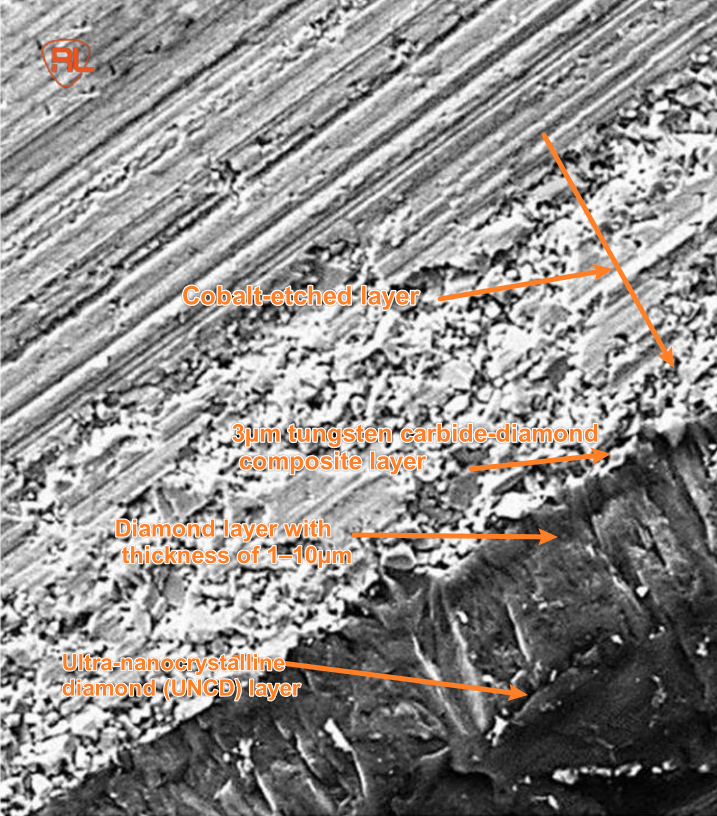
Metallographic images of nano-coatings
FAQ
Why Choose Relink Nano-Diamond Coating Technology?
Relink Nano Drawing Diesrepresent the pinnacle of wire processing technology. Utilizing advanced CVD (Chemical Vapor Deposition), we grow a dense layer of nanocrystalline polycrystalline diamond (PCD) onto a high-strength tungsten carbide substrate. This hybrid structure perfectly integrates the impact toughness of carbide with the extreme hardness of diamond.
1. Extreme Hardness & Ultra-Long Service Life
-
10,000 Vickers Hardness: The nano-coating hardness is nearly identical to natural diamond, far exceeding traditional tungsten carbide (approx. 1,800 HV).
-
10–20x Longer Lifespan: When processing low/medium carbon steel, stainless steel, and non-ferrous alloys, the wear resistance is vastly improved, drastically reducing die replacement frequency.
-
Superior Bore Stability: The ultra-slow wear rate ensures that wire diameters remain within micron-level tolerances across thousands of kilometers of drawing, preventing material waste caused by “over-tolerance” (oversized) wire.
2. Mirror-Like Surface Finish
-
Nanocrystalline Structure: Unlike standard diamond particles, the nano-scale grain structure provides an exceptionally smooth die bore surface.
-
Elimination of Galling & Metal Fines: High chemical inertness prevents metal adhesion (especially with Aluminum and Copper), completely solving the issues of surface scratches and burrs on the finished wire.
-
Enhanced Product Value: Ideal for high-precision applications like magnet wires and PV ribbon, delivering a flawless metallic luster.
3. Low Friction Coefficient & High-Speed Performance
-
Self-Lubricating Properties: The friction coefficient of the nano-diamond surface is extremely low (μ≈0.05), significantly reducing drawing resistance.
-
Support for High-Speed Drawing: Reduced friction leads to less heat accumulation. Even at high speeds exceeding 20m/s, the integrity of the lubricant is preserved, preventing wire annealing and extending the life of your drawing fluids.
-
Energy Efficiency: Lower drawing force requirements mean reduced motor load, potentially saving your facility 5%–10% in energy consumption.
4. 80% Reduction in Production Downtime
-
Continuous Productivity: Traditional TC dies require frequent inspections and changes. With Relink Nano Dies, your equipment can achieve significantly longer continuous operation cycles.
-
Low Maintenance Requirements: The die bore is resistant to buildup and scaling, extending maintenance intervals and allowing your production line to achieve “high output, low maintenance.”
Technical Specification Comparison (SEO Core Data)
| Feature | Relink Nano Die (CVD) | Traditional Carbide (TC) | Performance Boost |
|---|---|---|---|
| Vickers Hardness (HV) | 8,000 – 10,000 | 1,400 – 1,800 | 5x+ Hardness |
| Friction Coefficient (μ) | 0.05 – 0.1 | 0.2 – 0.4 | 75% Lower Friction |
| Surface Roughness (Ra) | < 0.05 μm | 0.1 – 0.2 μm | Mirror Finish |
| Typical Tool Life | 40,000+ Tons/Set | 4,000 Tons/Set | 10x Durability |
How Much Can Nano Die Improve High-Precision Surface Finish & Overall Efficiency?
Superior Surface Quality (High-Precision Surface Finish)
Feature: Mirror-Grade Polish & Ultra-Low Friction
Technical Details: Nano-crystalline diamond (NCD) coated dies deliver an exceptionally smooth high-precision surface finish thanks to their ultra-fine grain structure (typically 0.05 μm). The friction coefficient of the nano-diamond surface is only 0.05 – 0.1, significantly lower than the typical 0.25 of conventional tungsten carbide (TC) dies. This mirror-like polish is achieved through the combination of nano-scale diamond particles and post-deposition polishing, resulting in surface roughness values far superior to traditional materials.
Benefits for Engineers:
-
Minimizes heat generation during high-speed drawing by reducing frictional forces, which helps maintain stable process temperatures and prevents thermal damage to both the die and the wire.
-
Prevents surface scratches and defects, ensuring consistent wire quality even at elevated drawing speeds.
-
Delivers a true mirror-like finish on the drawn wire, critical for high-end applications such as electronic cables, automotive wiring harnesses, and precision conductors where surface integrity directly impacts conductivity, corrosion resistance, and aesthetic requirements.
-
Reduces generation of fines and dust, improving downstream processing cleanliness and overall yield.
-
Maintains hole geometry stability over an extended lifespan, supporting tighter dimensional tolerances and repeatable high-precision surface finish across long production runs.
In practical terms, field trials have shown that wires drawn through NCD-coated dies can achieve up to 28% lower surface roughness compared to standard carbide dies, along with lower residual stress in the finished wire.
This combination of high-precision surface finish and ultra-low friction makes Nano Die (NCD-coated dies) an ideal upgrade for engineers seeking to optimize wire drawing processes for demanding industries like electronics, automotive, and specialty cable manufacturing.
Typical Performance Comparison:
| Item | Traditional Tungsten Carbide Die | NCD Nano Die | Improvement |
|---|---|---|---|
| Die Lifespan | Baseline (1×) | 8–20× | 8–20 times |
| Die Change Frequency | High | Extremely low | Reduced by 80–95% |
| Drawing Speed | Baseline | Can be increased | 10–30%+ (depending on process) |
| Material Waste | Higher | Reduced | Savings of 2–3%+ |
| Overall Production Efficiency | Baseline | Significantly improved | 2–5 times+ (depending on scenario) |
Important Notes: Actual improvement depends heavily on the wire material (steel, copper, aluminum, etc.), diameter, drawing machine type, and original process conditions. It is recommended to conduct small-batch trials and comparisons in your specific application to obtain the most accurate data.
If you provide more details (such as the wire material, diameter, current drawing speed, and existing die lifespan), I can offer more targeted efficiency estimates or optimization suggestions.
What Factors Affect Wire Drawing Efficiency? How Much Efficiency Can Nano Die (NCD Coating) Improve?
Wire drawing efficiency is usually measured by comprehensive indicators such as output per unit time (meters/hour or tons/hour), equipment utilization rate, energy consumption, and yield rate. The following are the main factors that influence wire drawing efficiency (based on industry practice and research):
-
Die Material and Design: Fast die wear leads to changes in hole diameter, surface roughness, and frequent die changes, directly reducing speed and uptime. Geometric parameters such as die angle, bearing length, and back relief angle affect friction force and deformation uniformity.
-
Lubrication Conditions: Inadequate lubricant type, cleanliness, or supply increases the friction coefficient, generates excessive heat, accelerates die wear, and can even cause wire breakage or surface scratches.
-
Wire Material Properties: Differences in wire strength, hardness, ductility, surface quality, and impurity content significantly affect the required drawing force, area reduction ratio, and risk of wire breakage.
-
Drawing Speed and Process Parameters: Excessively high speed generates too much heat, increases friction, and affects wire performance. Too large a reduction ratio can also cause wire breakage or surface defects.
-
Temperature Control: Frictional heat generated during drawing raises temperature, which accelerates oxidation, die wear, and changes in wire properties.
-
Equipment Factors: Machine alignment, tension stability, cooling system, and maintenance level all affect operational stability.
-
Operation and Management: Die change time, frequency of die inspection, and raw material consistency can cause downtime losses.
These factors interact with each other and ultimately determine the overall equipment effectiveness (OEE).
Efficiency Improvement After Using Nano Die (Nano-Crystalline Diamond Coated Dies)
Nano Die refers to black wire drawing dies with a nano-crystalline diamond (NCD) coating (grain size 5–50 nm) deposited via CVD technology on a tungsten carbide or similar substrate (as shown in the left image of the horizontal comparison, in clear contrast to the silver substrate dies on the right). Thanks to its extremely low friction coefficient (<0.05), ultra-high hardness (close to natural diamond), and mirror-like surface finish, it significantly improves multiple bottlenecks mentioned above.
Specific Efficiency Gains (based on industry field tests and literature):
-
Die Lifespan Increased by 5–20 Times (most commonly 8–15 times): Compared with traditional tungsten carbide dies, NCD-coated dies can last 8–20 times longer in applications such as steel wire, copper wire, and cable stranding. This dramatically reduces the frequency of die changes and downtime.
-
Higher Drawing Speed: Lower friction combined with the mirror-smooth surface reduces drawing force, allowing higher drawing speeds on the same equipment while reducing heat generation and lubricant consumption (some users report ~30% reduction in lubricant usage).
-
Material Savings and Improved Yield: Stable hole diameter and superior surface quality reduce wire scrap and dust. Some Nano Die users achieve 2–3% savings in raw metal material and significantly higher yield rates.
-
Overall Production Efficiency / Capacity Increase: Because die change frequency is greatly reduced (downtime can drop by 80–90% or more), equipment utilization and output per unit time improve significantly. In high-volume production lines, total efficiency (overall capacity) typically increases by 2–5 times or more, depending on the original process bottlenecks and wire types. In the long term, total cost of ownership (TCO) decreases substantially.
Typical Performance Comparison:
| Item | Traditional Tungsten Carbide Die | NCD Nano Die | Improvement |
|---|---|---|---|
| Die Lifespan | Baseline (1×) | 8–20× | 8–20 times |
| Die Change Frequency | High | Extremely low | Reduced by 80–95% |
| Drawing Speed | Baseline | Can be increased | 10–30%+ (depending on process) |
| Material Waste | Higher | Reduced | Savings of 2–3%+ |
| Overall Production Efficiency | Baseline | Significantly improved | 2–5 times+ (depending on scenario) |
Important Notes: Actual improvement depends heavily on the wire material (steel, copper, aluminum, etc.), diameter, drawing machine type, and original process conditions. It is recommended to conduct small-batch trials and comparisons in your specific application to obtain the most accurate data.
If you provide more details (such as the wire material, diameter, current drawing speed, and existing die lifespan), I can offer more targeted efficiency estimates or optimization suggestions.
Keywords: wire drawing efficiency, factors affecting wire drawing, nano die, NCD coated wire drawing dies, nano crystalline diamond dies, wire drawing die lifespan, improve wire drawing productivity, NCD vs carbide dies, cost effective wire drawing, wire drawing speed, die change frequency, wire drawing yield
What is Nano-Crystalline Diamond Coating?
Nano-crystalline Diamond Coating (NCD) is a thin film coating grown on a substrate surface using techniques such as Chemical Vapor Deposition (CVD). Its diamond grain size is typically in the range of a few nanometers to about 100 nanometers (commonly 5–50 nm), which is much smaller than that of traditional microcrystalline diamond (where grains can reach the micrometer scale). This nanoscale grain structure makes the coating surface extremely smooth and flat, while retaining most of the excellent properties of diamond.
Main Characteristics
-
Extremely High Hardness and Wear Resistance: Close to the hardness of natural diamond (Mohs hardness 10), it can significantly improve the substrate’s resistance to scratching and wear.
-
Low Friction Coefficient: Can be as low as that of single-crystal diamond (sometimes <0.05), providing a self-lubricating effect that reduces frictional heat and energy loss.
-
Smooth Surface: Due to the fine grains, the surface roughness is very low. It can achieve a mirror-like finish without additional polishing, making it suitable for precision applications.
-
High Chemical Inertness and Corrosion Resistance: Resistant to acids, alkalis, oxidation, and high temperatures (up to approximately 600°C in air, and even higher in vacuum). It also has good biocompatibility.
-
High Thermal Conductivity: Diamond has an inherently high thermal conductivity, which helps with heat dissipation.
-
Others: Can be doped with boron or nitrogen to achieve electrical conductivity; high optical transparency (some transparent NCD coatings have over 80% transmittance); thickness is usually 0.1 to several micrometers. It can be deposited at relatively low temperatures, making it compatible with various substrates (such as metals, ceramics, silicon, etc.).
Compared with Diamond-Like Carbon (DLC) coatings, NCD is closer to pure diamond (with a higher sp³ bonding ratio), and its hardness and thermal stability are often superior. However, DLC is easier to deposit and sometimes offers better flexibility. NCD is also sometimes associated with ultra-nanocrystalline diamond (UNCD, with grain sizes of 2–5 nm), which may contain a small amount of sp² carbon at the grain boundaries.
Preparation Methods
It is mainly prepared using Microwave Plasma CVD (MPCVD), Hot-Filament CVD, or Radio-Frequency Plasma CVD technologies in a plasma environment containing a carbon source (such as methane) and hydrogen. The substrate requires pretreatment (such as a seeding layer) to promote nucleation. Compared with traditional diamond coatings, NCD can be grown at lower temperatures, reducing thermal damage to the substrate.
Main Application Fields
-
Cutting Tools and Molds: Coating drill bits, milling cutters, nano wire-drawing dies, etc., to increase service life and reduce adhesion. It is particularly suitable for machining graphite, aluminum alloys, composite materials, and similar materials.
-
Mechanical and Tribological Applications: Used in bearings, seals, and other low-friction scenarios, or as reinforcement material in lubricant additives.
-
Biomedical Applications: Coating artificial joints and implants (such as Ti6Al4V alloy) to improve biocompatibility, reduce wear and metal ion release, and promote bone integration.
-
Optics and Electronics: Transparent protective coatings, optical windows, MEMS/NEMS devices, field emission devices, etc.
-
Others: Semiconductors, sensors, corrosion-resistant coatings, high-power electronic devices, etc.
In summary, Nano-crystalline Diamond Coating combines the extreme performance of diamond with the smoothness advantage of nanomaterials. It is a highly regarded surface modification technology in high-end manufacturing, medical, and precision engineering fields. Actual performance may vary depending on the preparation process, doping, and substrate. If you have a specific application scenario (such as tool coating or medical implants), feel free to provide more details, and I can explain further.
Can Nano Dies replace Tungsten Carbide (TC) dies?
A: In most wire drawing applications, Nano Dies are the ideal upgrade for TC dies. While the initial cost is higher, the Total Cost of Ownership (TCO) is much lower due to 95% less downtime and 60x longer tool life.
Can Nano Dies actually save raw materials?
A: Yes. Because Nano Dies are virtually wear-resistant, the bore diameter remains constant. You don’t need to “oversize” the wire to compensate for eventual die wear, saving significant amounts of expensive metal over long production runs.
How does mirror nano coating compare to PCD or single-crystal diamond coatings?
PCD (polycrystalline diamond) offers superior wear resistance and is better for high-wear coarse wires; mirror nano coating excels in fine wire applications requiring extreme surface quality (mirror finish + low friction) at a lower cost and is easier to apply to large-diameter drums. PCD is mainly used for die holes, while mirror nano is more suitable for external drum surfaces.
Can mirror nano coating be repaired or recoated?
Yes. Most suppliers support multiple recoating cycles (3–5 times or more). The process includes: stripping old coating → substrate repair → re-hardfacing/spray → nano mirror precision finishing. Recoating cost is typically 50–70% of a new coating, making it an economical way to extend drum life.
How much does mirror nano coating increase equipment cost?
Compared to standard tungsten carbide spraying, mirror nano coating typically adds 20–60% to the surface treatment cost (depending on drum size and coating type). However, through extended service life, reduced downtime, and improved wire quality (lower scrap rate), the ROI (return on investment) is usually recovered within 6–18 months, especially in 24/7 high-end wire production facilities.
How to maintain and clean mirror nano coated drums?
Daily: Wipe with a soft cloth and neutral cleaner; avoid abrasive tools.
-
Shutdown cleaning: Use compressed air to remove dust; use specialized nano cleaners if needed.
-
Avoid: Strong acids/alkalis, sandpaper grinding, high-temperature baking.
-
Periodic check: Monitor surface roughness; if Ra > 0.8 μm, return for recoating/polishing.
How long is the service life of mirror nano coated drums?
Under normal lubrication and high-speed drawing conditions, high-quality mirror nano coated drums can last 15,000–30,000 hours (approximately 1.5–3 years of continuous production), 30–100% longer than standard tungsten carbide coatings. Lifespan depends on wire hardness, reduction ratio, cooling efficiency, dust content, etc. When noticeable wear appears, recoating or refurbishment is recommended.
What is the typical coating thickness? Does it affect drum dimensions?
Typical thickness is 5–15 μm (nano-level coatings are usually <10 μm), while hardfacing base layers can be 0.5–5 mm before the nano mirror finish. The coating is very thin, with negligible impact on original drum dimensions (<0.02 mm change), but it dramatically improves surface performance. After recoating, precision grinding and polishing restore the mirror finish.
Which wires and equipment is mirror nano coating suitable for?
It is best suited for non-ferrous and low-carbon steel fine to medium-fine wire drawing, such as copper, aluminum, alloy wires, precious metals (gold, silver, platinum), and fine stainless steel. Commonly used on high-speed capstans/drums (Ø400–800 mm) in straight-line or multi-die wire drawing machines. For coarse wires or highly abrasive high-carbon steel, PCD or standard carbide may be more cost-effective.
What are the main advantages of mirror nano coating?
Mirror-like smoothness: Significantly improves wire surface quality, reducing bamboo defects, scratches, and ovality.
-
Low friction: Reduces drawing power consumption and heat generation, ideal for high-speed operation (>20 m/s).
-
High wear resistance: Hardness typically HRC 65–75+, with good oxidation and corrosion resistance; service life can reach 15,000–30,000 hours (depending on coating thickness and conditions).
-
Anti-adhesion: Wire is less likely to stick to the drum, lowering tangling and breakage rates.
-
Easy cleaning: Smooth surface minimizes metal dust accumulation.
What is the difference between mirror nano coating and traditional tungsten carbide spraying?
Traditional tungsten carbide (WC) spraying provides high hardness (HRC 60+), but surface roughness is typically Ra 0.8–1.6 μm, which can cause micro-scratches. Mirror nano coating adds a nanoscale precision polishing layer on top of tungsten carbide or other base materials, achieving much smoother surfaces (Ra < 0.6 μm), reducing the friction coefficient by 30–50%, preventing wire jumping/pressing, and making it especially suitable for high-speed, high-precision fine wire drawing. Service life can be extended by 20–100% (depending on operating conditions).
What is mirror nano coating?
Mirror nano coating is an ultra-smooth, high-hardness coating formed on metal surfaces using nanoscale materials (such as nano tungsten carbide, nano ceramics, nano diamond, or composite alloys) combined with processes like PVD, CVD, thermal spraying, or electroplating. The surface roughness can reach Ra ≤ 0.1–0.6 μm (near-mirror finish), while offering extremely low friction coefficient and excellent wear resistance. In wire drawing machines, it is commonly applied to capstan/drum surfaces to reduce wire adhesion, minimize frictional heat, and improve the final wire surface quality.