
Extrusion Tip and Dies FAQ: 12 Crucial Answers for Cable Extrusion
FAQ
What is extrusion die?
Extrusion dies are mold components used in the extrusion molding process: when materials (such as metals, plastics, rubber, etc.) are pushed or forced through the die under pressure, they acquire a specific cross-sectional shape at the die exit, thereby forming continuous products (profiles, tubes, rods, strips, etc.).
Key Features:
-
Determines cross-sectional shape: The die profile corresponds to the final product’s external shape, internal bore, wall thickness, etc.
-
Influences forming quality: Including surface quality, dimensional tolerances, wall thickness uniformity, tensile/stress conditions, etc.
-
Common materials and structures: Typically manufactured from high-strength, wear-resistant materials (e.g., tool steel, cemented carbide, ceramics, etc.) and may incorporate cooling or heating structures.
Typical Applications
-
Metal Profile Extrusion: Such as aluminum profiles, copper bars, and tubes.
-
Plastic Extrusion: Such as pipes, sheets, profiles, and flooring profiles.
-
Rubber Extrusion: Such as sealing strips and custom-shaped seals.
If you could specify whether you are asking about metal or plastic extrusion, as well as the general product shape (tube/profile/sheet/special-shaped), I can provide further details on common die configurations (such as single-cavity/multi-cavity, mandrel, core shaft, calibration section, etc.) and common issues that may arise.
How should extrusion tips and dies be properly aligned or adjusted during setup?
Common methods include empty alignment (dry fitting), gel run (hot material without wire), and wire run adjustments. Always loosen screws in a cross pattern before tightening to avoid damage. Relink provides guidance and custom tooling to simplify setup and achieve smooth, defect-free production.
What causes eccentricity or uneven insulation thickness, and how can Relink tools help prevent it?
Eccentricity often results from poor tool alignment, incorrect bearing lengths, improper taper angles, or worn inserts. Relink tools feature ultra-precise concentricity (up to 0.005 mm) and optimized designs to maintain perfect conductor centering, delivering uniform wall thickness and reducing scrap.
How does the tip (core) hole diameter affect cable quality?
The tip hole diameter controls conductor guidance and material distribution.
-
Too small: Increases friction, risking conductor tension instability or breakage.
-
Too large: Leads to uneven insulation thickness, eccentricity, or diameter fluctuations. Relink recommends precise sizing based on your conductor diameter and material for optimal centering and quality.
Why is the taper angle design important in extrusion dies, and what happens if it’s incorrect?
The inner taper angle of the die must be larger than the outer angle of the tip to create proper pressure and material flow. If the die angle is too small or equal, it can cause excessive pressure buildup, material scorching, or uneven flow. Relink precisely engineers taper angles in our dies to ensure smooth extrusion, uniform thickness, and minimal defects.
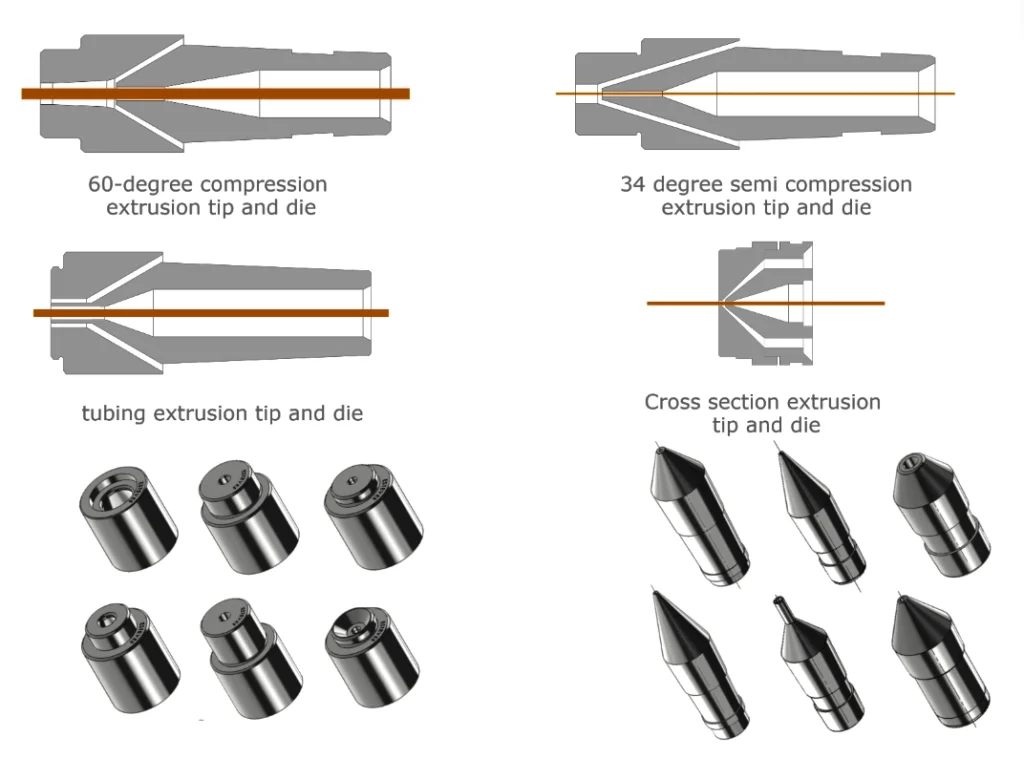
What are the differences between extrusion-style, tube-style, and semi-extrusion tooling for wire and cable?
-
Extrusion-style (no extended tip): Ideal for tight bonding between conductor and insulation, as the material is applied under pressure inside the crosshead. Best for core insulation requiring strong adhesion.
-
Tube-style (long extended tip): Forms a loose tube that is drawn down onto the conductor, suitable for sheathing or applications needing less tight bonding.
-
Semi-extrusion (short extended tip): A balanced approach with partial extension for moderate adhesion and control. Relink offers all three configurations to match your specific insulation or sheathing needs.