

How Can Wire Drawing Companies Use Nanotechnology to Break Through?
In this article
- **Introduction: A Breather After the Surge—Opportunity or Trap?**
- **The “Cost Trap” of Cemented Carbide Dies**
- **[Nano Drawing Die](/wire-cable-manufacturing/wire-drawing-die/nano-die/): A Strategic Choice to Break the Tungsten Shackles**
- 1. Decoupling from Tungsten Price Volatility
- 2. Superior Performance for Real “Cost Reduction & Efficiency”
- **Conclusion: From Passive Acceptance to Active Transformation**
Tungsten Prices Enter Volatility: How Can Wire Drawing Companies Use Nanotechnology to Break Through?
Keywords: Tungsten Price Trends, APT Quotes, Cemented Carbide, Nano Drawing Die, Wire Drawing Industry, Relink, Cost Reduction, Material Substitution, Strategic Sourcing.
Introduction: A Breather After the Surge—Opportunity or Trap?
For the wire drawing industry, which relies heavily on tungsten resources, the start of 2026 has been a roller coaster. Prices for tungsten concentrate previously shattered historical highs, surpassing 1.05 million CNY/standard ton, leaving mid-to-downstream enterprises struggling to maintain margins.
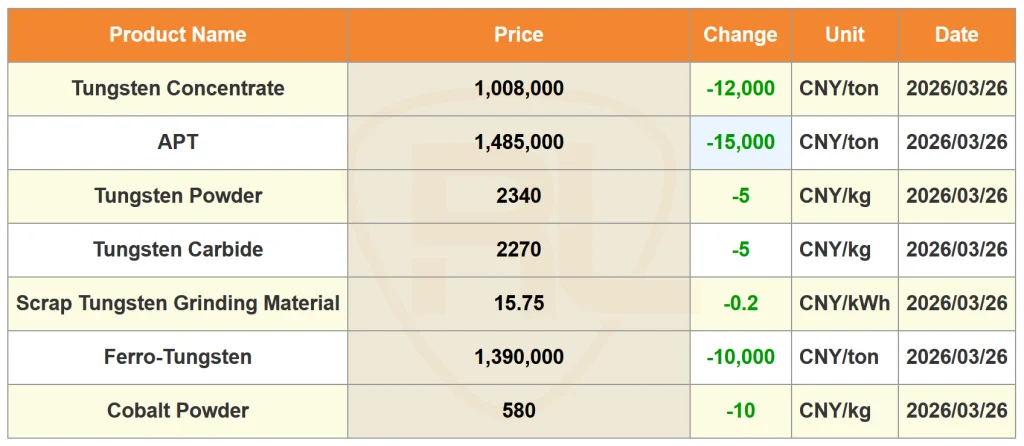
According to the latest market data for March 26, 2026 (see table below), Tungsten Concentrate and APT (Ammonium Paratungstate) have seen a slight correction, dropping by 12,000 CNY and 15,000 CNY per ton, respectively. But does this signal the end of the price surge?
| Product Name | Price (2026/03/26) | Change | Unit |
| Tungsten Concentrate | 1,008,000 | -12,000 | CNY/ton |
| APT | 1,485,000 | -15,000 | CNY/ton |
| Tungsten Carbide | 2,270 | -5 | CNY/kg |
Industry analysis suggests today’s correction is a technical pullback driven by “price fatigue” and profit-taking after the massive rally. Given the strategic scarcity of global tungsten, rising mining costs, and geopolitical factors, the underlying logic for high tungsten prices remains unchanged. The marginal drop in Tungsten Carbide powder (only -5 CNY/kg) indicates that finished product prices are unlikely to see significant relief in the near term.
Faced with sustained high raw material costs, how can wire drawing companies protect themselves and even gain a competitive edge?
The “Cost Trap” of Cemented Carbide Dies
For decades, Tungsten Carbide (Cemented Carbide) dies have been the workhorse of the wire drawing industry. However, under current market conditions, the disadvantages of relying solely on these dies are becoming magnified:
-
Soaring Procurement Costs: Tungsten Carbide powder accounts for the lion’s share of die manufacturing costs. Every percentage point increase in tungsten prices directly erodes the profit margins of wire producers.
-
Supply Chain Risks: Tungsten is a highly concentrated resource with volatile and uncontrollable price swings. Over-reliance on carbide dies leaves production costs vulnerable to external market shocks.
-
Performance Bottlenecks: While durable, carbide dies often hit a ceiling in ultra-fine or high-strength wire drawing. Issues with service life, surface finish, and hole diameter stability lead to frequent die changes, further driving up operational costs.
Nano Drawing Die: A Strategic Choice to Break the Tungsten Shackles
In an era of long-term tungsten price hikes and supply risks, seeking high-performance alternative materials is no longer an option—it is a necessity for survival.
The Nano Drawing Die by Relink was specifically developed to solve the dual bottleneck of cost and performance inherent in traditional carbide dies. It provides a clear technical path for the industry to hedge against the risks of the tungsten market.
1. Decoupling from Tungsten Price Volatility
The core material of the Nano Drawing Die is no longer high-cost tungsten, but Nano-crystalline Diamond and other advanced nano-composite materials.
-
Immunity to Tungsten Trends: The raw material for nano-diamond (carbon) is abundant, and industrial synthesis technology is mature. Its price is stable and unaffected by the scarcity or geopolitical constraints that plague tungsten.
-
Controllable Budgets: By adopting Nano Drawing Dies, companies can decouple their die procurement from the volatile tungsten market, ensuring financial predictability and resilience.
2. Superior Performance for Real “Cost Reduction & Efficiency”
Relink’s Nano Drawing Die goes beyond mere substitution; it offers a massive leap in technical performance that translates into direct economic benefits:
-
Extreme Service Life: The hardness and wear resistance of nano-diamond far exceed that of cemented carbide. A Nano Drawing Die can last 10 to 50 times longer than a traditional carbide die. This results in:Fewer dies purchased annually.Drastically reduced downtime for die changes, boosting equipment utilization.
-
Premium Surface Finish: The nano-crystalline structure creates an ultra-smooth die surface with a low friction coefficient. This produces wires (copper, stainless steel, or fine alloys) with superior brightness and smoothness, enhancing the final product’s market value.
-
Hole Diameter Stability: Exceptional hardness ensures that the die aperture remains consistent over long production cycles, maintaining strict tolerances and reducing scrap rates.
Conclusion: From Passive Acceptance to Active Transformation
The price dip on March 26 is merely a ripple in a long-term trend. For wire drawing enterprises, continuing to rely solely on the traditional tungsten carbide path means remaining a “hostage” to raw material price spikes.
Integrating Relink’s Nano Drawing Dies is a strategic technical upgrade. It allows companies to mitigate supply chain risks while achieving tangible gains in efficiency and wire quality. In an uncertain resource market, the future belongs to those who embrace material innovation to secure their margins.
About Relink
Relink specializes in providing advanced super-hard material solutions for the global metal processing industry. Our Nano Drawing Die series has been successfully deployed in high-performance wire drawing applications worldwide. Contact us today to learn how we can help you optimize your process and navigate raw material challenges.
Did this answer your question?