
Why Did the Price of Tungsten Concentrate Suddenly Drop By CNY 20,000 Today?
In this article

Overview
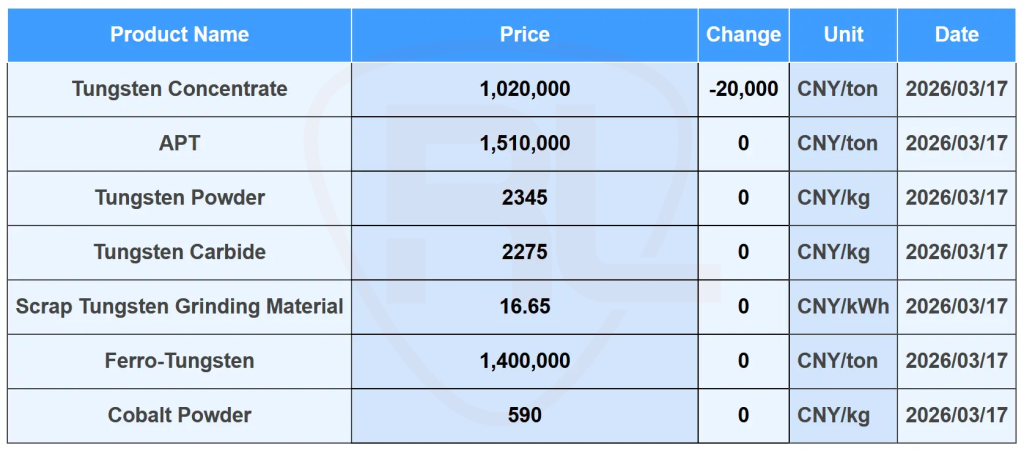
This is a market signal that warrants close attention. Against the backdrop of an “epic” surge in tungsten prices in early March 2026 (with concentrate prices briefly breaking through the 1 million CNY/ton mark), today’s sudden drop of 20,000 CNY/ton in concentrate prices—though representing only about a 2% decline from the million-level baseline—sends a signal that cannot be ignored:
1. Market Interpretation: Volatility at High Levels and Fear of Falling Prices
Price Correction: From early 2026 to mid-March, the cumulative increase in tungsten concentrate prices exceeded 120–130% (soaring from approximately 450,000–500,000 CNY at the start of the year to over 1 million CNY). Daily jumps of 20,000–60,000 CNY were common, but after a prolonged one-sided rally, market sentiment became increasingly cautious. Downstream hard alloy and cutting tool manufacturers faced immense cost pressures, leading them to slow their procurement pace or even adopt a wait-and-see approach.
Following the frenetic surge of nearly 130% since the start of the year, market “fear of heights” has long been building up. Today’s decline appears more like a concentrated cash-out by profit-taking positions from earlier gains rather than a reversal in fundamentals.
Divergence in Price Movements: It is worth noting that “ other tungsten products remain unchanged”. This indicates that downstream APT (ammonium paratungstate), tungsten powder, and cemented carbide have not yet followed the downward trend. Such divergence typically reflects that downstream factories are still working through high-priced inventory or remain cautious about future market conditions; in the short term, pressure from the raw material side has not yet been passed on to the finished product side.
2. Potential Influencing Factors
Supply-Demand Dynamics: Although the tariff exemption policy effective in September 2025 has alleviated cost pressures to some extent, strict controls on domestic mining quotas and safety inspections remain the primary factors supporting the floor price. Some holders and mines have chosen to realize profits at high price levels, leading to increased short-term supply pressure and weaker spot market transactions.
Downstream Price Pass-Through Lag: Prices for mid-to-downstream products such as APT and tungsten powder remain firm (APT trading around 1.50–1.52 million CNY/ton, tungsten powder around 2,400 CNY/kg), but end-user demand (e.g., machining, photovoltaics, new energy) has limited tolerance for extremely high raw material prices. Reduced buying interest has triggered a correction in upstream prices.
Slowing strategic demand? Caution is warranted regarding a potential slowdown in demand growth following the peak penetration of tungsten wire in the solar sector, or phased adjustments in procurement cycles within the defense and semiconductor sectors.
Macroeconomic and geopolitical factors: Support from strategic metal attributes remains (Sino-U.S. competition over critical minerals, expectations of export controls), but with a lack of new positive catalysts in the short term, the market has entered a phase of “self-correction and stress testing.”
3. Business Recommendations for You
As a seasoned professional in the cemented carbide sector, particularly given your current focus on Relink’s development, this market volatility may have the following implications:
Procurement: If your production lines (e.g., nano-drawing dies, roll rings, etc.) have recent raw material restocking needs, monitor whether this downturn creates a ripple effect that could lead to a softening of APT prices.
#TungstenConcentratePrice #TungstenPriceSurge #GeopoliticalDynamics #ChinaTungstenSupply #FerrotungstenPriceTrend #TungstenProductPrice
Did this answer your question?