

Navigating the Tungsten Price Deadlock & Its Impact on Carbide Roller Rings
In this article

Is the Calm Before the Storm? Navigating the Tungsten Price Deadlock and Its Impact on Carbide Roller Rings
Beneath the surface of a seemingly quiet market lies a fierce tug-of-war between buyers and sellers entering a phase of rational observation.
As we move through 2026, the tungsten market is showing clear signs of divergence. On one hand, raw material prices remain stagnant at historic highs due to a supply-demand deadlock. On the other, the tungsten scrap market is under downward pressure as capital liquidity tightens. This complex environment is profoundly reshaping the strategy for every player, from mining giants to precision tool manufacturers.
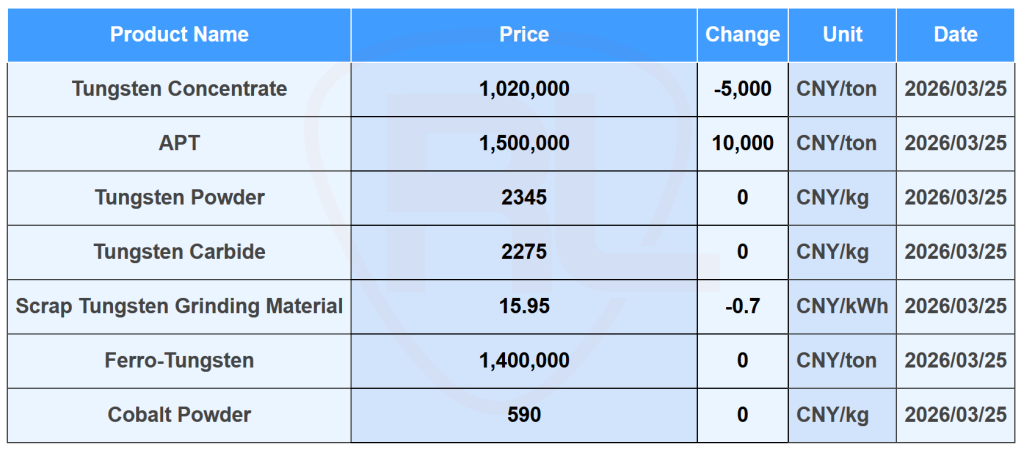
1. Three Variables Dominating the Tungsten Landscape
The core logic driving tungsten prices has shifted from simple supply-and-demand to a multi-dimensional gamble:
Supply-Demand Dynamics: Both supply release and demand pickup are moving at a sluggish pace. While Black Tungsten Concentrate and Scheelite Concentrate prices have surged by approximately 122.8% and 123.1% since the start of the year, procurement remains extremely cautious.
Capital & Liquidity: Risk appetite in the global market is decreasing. Some holders are facing pressure to liquidate for cash flow, leading to increased short-term volatility.
Macro Environment: Global geopolitical instability and rising energy costs are trickling down the supply chain, further compressing the profit margins of midstream and downstream enterprises.
2. High-Cost Era: The Challenge for Tungsten Carbide Roller Rings
In this storm of skyrocketing costs, downstream manufacturers of Tungsten Carbide Roller Rings are facing an unprecedented test.
As a critical component in the rolling of steel bars and wire rods, the quality of the roller ring directly dictates the surface precision of the final product. However, with Tungsten Carbide Powder (WC Powder) prices soaring to 2,320 RMB/kg—more than doubling since the beginning of the year—the stakes have never been higher.
The Cost Burden: Roller rings are bulky and material-intensive. This price jump has dramatically inflated inventory and production costs.
Performance Demands: Faced with high unit costs, steel mills are demanding near-perfect wear resistance, thermal crack resistance, and extended service life to justify the investment.
To thrive in this environment, industry leaders like RELINK are focusing on high-purity virgin materials. By ensuring that every Tungsten Carbide Roller Ring maintains peak stability in high-speed rolling environments, they provide the reliability needed in an era of resource scarcity.
3. The “Ice and Fire” of the Scrap Market
Interestingly, while raw materials remain firm, the Tungsten Scrap market is weakening. Prices for scrap tungsten bars and drill bits are hovering around 1,100 RMB/kg and 1,080 RMB/kg, respectively. Some holders, pressured by pessimistic expectations or the need for quick turnover, have begun “panic selling,” pushing price levels downward.
This disconnect—stable raw materials vs. falling scrap—offers a strategic window for manufacturers with advanced processing capabilities to balance their heavy raw material burdens through scientific recycling and blending.
Conclusion: Survival Tactics in a Complex Gridlock
Tungsten price trends have transcended cyclical fluctuations; they now represent a fundamental restructuring of resource pricing power. With a global supply gap projected to exceed 20,000 tons in 2026, market participants must find balance within this “rational observation” phase.
For downstream users, a simple low-price strategy is a dead end. Only by focusing on high-end Tungsten Carbide Roller Rings that offer a “technology premium”—and by keeping a close eye on scrap market opportunities—can companies survive this brutal industry shakeout.
Keywords: Tungsten Carbide Roller Ring, WC Powder, Tungsten Market Trends, Hard Alloy, Scrap Recycling, Virgin Materials, Steel Rolling Tools.
Did this answer your question?