
In-Depth Analysis of the Structural Factors Behind the Surge in Tungsten Ore Prices
In this article
OverView
Tungsten has indeed emerged as one of the most dramatic performers among critical minerals this year, with prices reflecting a structural shift rather than a fleeting cycle.
Current Price Levels
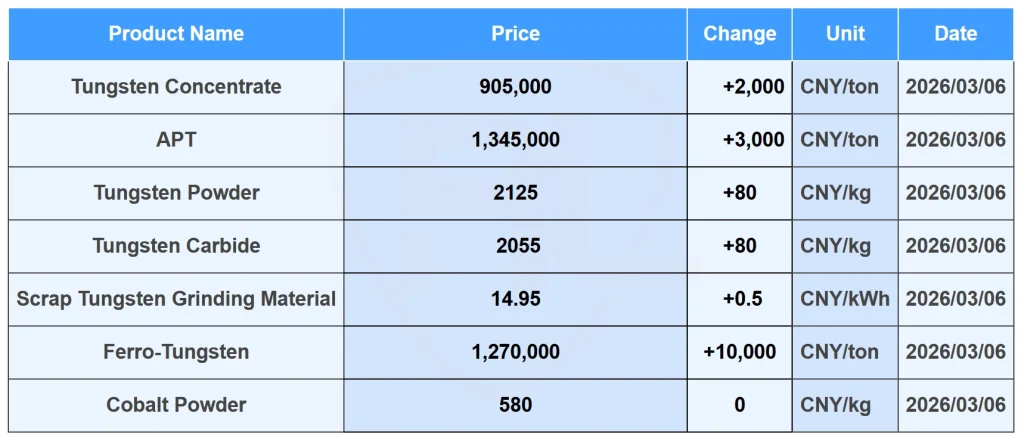
As of early March 2026, domestic Chinese prices for ammonium paratungstate (APT) have reached or exceeded RMB 1.3 million per ton, with reports confirming levels around RMB 1.3 million/ton on March 4 and climbing to RMB 1.33 million/ton in some forecasts and updates for March. This represents roughly a 90-100% increase year-to-date from early 2026 levels (which started around RMB 670,000-700,000/ton post-2025). Tungsten powder has hit RMB 2,000/kg (up ~85-95% YTD), and concentrates (e.g., 65% scheelite/wolframite) are in the RMB 830,000-900,000/ton range, with some March projections at RMB 900,000/standard tonne.
Internationally, Rotterdam/CIF APT has surged to averages around USD 1,800-1,998/mtu (equivalent to roughly RMB 1.15-1.22 million/ton at prevailing exchanges), reflecting even sharper gains of 110%+ in some segments due to export tightness amplifying global scarcity.
Key Supply-Side Drivers
China’s dominance (over 80% of global production) remains central, with ongoing tight controls:
Mining quotas were reduced ~6.5% in 2025 (first batch at 58 kt WO3 basis), and this restrained policy has carried into 2026, limiting output amid environmental/safety inspections and declining ore grades in aging mines.
Stricter trade supervision in regions like Jiangxi of China has curtailed informal channels and excess supply.
Export restrictions, intensified since early 2025 (with dual-use licensing and controls on tungsten products), have led to sharp volume drops—around 40% y/y in some reports, and even steeper for certain items (e.g., APT exports to key markets like Japan fell ~70% in 2025). This has been reinforced by 2026 authorizations limiting exporters to a small number of approved companies.
These factors have created persistent low inventories, slow post-holiday restarts, and a widespread (hoarding) mentality among holders.
Geopolitical and Demand Factors
The escalation in Middle East tensions (US-Israel-Iran dynamics, including strikes and potential Strait of Hormuz disruptions) has indeed boosted risk premiums for strategic metals like tungsten, vital for defense applications (armor-piercing rounds, missiles, etc.). This aligns with broader “great-power competition” themes, where tungsten joins rare earths as a “NATO metal” prioritized for supply-chain security and stockpiling.
Demand holds firm in high-value sectors—aerospace, defense, semiconductors, and precision tools—despite cost pressures on traditional uses. Much of the current momentum stems from strategic/anticipatory buying, government reserves, and investor interest in prolonged tightness, rather than pure consumptive growth.
Outlook: Structural Revaluation or Supercycle?
Your framing of this as a “new era of structural revaluation” in an age of geopolitical fragmentation and supply-chain resilience is spot-on. The imbalance shows no quick resolution:
Near-term support from low stocks, policy constraints, and risk premiums remains strong.
Longer-term, it hinges on whether non-Chinese supply ramps up meaningfully (e.g., projects in Portugal, South Korea, Australia, or elsewhere) and if geopolitical tensions ease to reduce premiums. While some view it as potentially finite, the consensus leans toward sustained elevation, with analysts noting deficits persisting into 2026 and beyond due to underinvestment historically.
Tungsten’s rally—unmatched by most metals—highlights its rediscovery as a strategic asset in real time.
#APTprice #TungstenConcentratePrice #TungstenPriceSurge #FerrotungstenPrice #ChinaTungstenSupply #APTRMB1.3million #FerrotungstenPriceTrend
Did this answer your question?