
How to Efficiently Create Perfect Metal Wires?
In this article
- Did You Know? The Unsung Hero of Modern Life
- What is Wire Drawing Die Matching? A “High-Efficiency Slimming Plan” for Metal Wires
- Core Challenge: The Invisible “Slip” That Determines Success or Failure
- Three Classic Die Matching Methods: The Crystallization of Engineering Wisdom
- Conclusion: An Art That Blends Science and Experience
Did You Know? The Unsung Hero of Modern Life
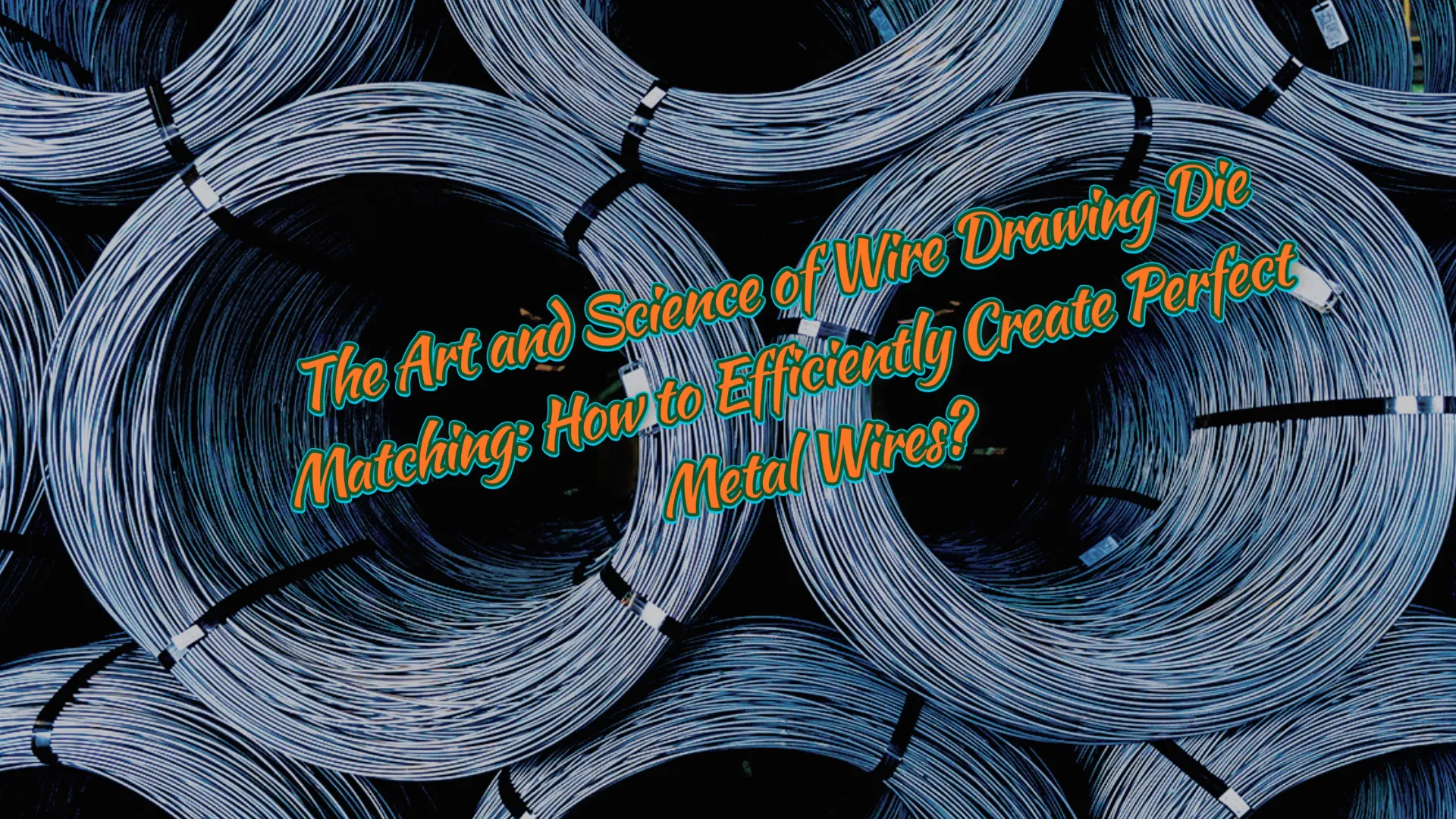
From the smartphones in our pockets to the various tools we use in daily life, countless products rely on an unsung hero—metal wires.
But have you ever wondered how a thick metal rod transforms into a slender yet strong metal wire? This magical journey is hidden within a precise technique called “wire drawing die matching.”
What is Wire Drawing Die Matching? A “High-Efficiency Slimming Plan” for Metal Wires
Simply put, “wire drawing die matching” is like a tailored “high-efficiency slimming plan” for metal wires. Its goal is to design the most perfect path, allowing a metal rod to be drawn through a series of dies to precisely achieve the desired thickness, performance, and quality.
This isn’t just about brute-force pulling—it’s a comprehensive science that combines material selection, process planning, data calculations, and real-world experience.
Core Challenge: The Invisible “Slip” That Determines Success or Failure
Imagine this: the power wheel of the wire drawing machine (called the capstan) rotates at a fixed speed ratio, but as the metal wire is drawn thinner, its forward speed keeps increasing. The speed difference between these two creates a critical parameter—the “slip coefficient.”
This coefficient is like the accelerator pedal when driving. If controlled just right, the metal wire forms smoothly and efficiently. But if mishandled, it could lead to scratches on the wire’s surface at best, or at worst, a broken wire, or even scrapping an entire batch of products. Mastering this precision is where engineers showcase their expertise.
Three Classic Die Matching Methods: The Crystallization of Engineering Wisdom
So, how do engineers cleverly tackle this challenge? Beyond relying on the experience passed down by seasoned craftsmen, the industry has developed three classic theoretical methods:
Absolute Slip Coefficient Method (J Method) — Stable Flow Method
This method is akin to the “law of conservation of mass” in physics. Its core principle ensures that the volume of metal passing through each die per unit of time remains constant, like a river with a steady flow, enabling the most continuous and stable production.
Traditional Theoretical Die Matching Method (C Method) — Reverse Engineering Method
This is a brilliant “reverse engineering” approach. It starts with the desired final product (the thinnest wire) and works backward to calculate the die sizes for each step. By setting a clear target first, it reverse-engineers the path to achieve it.
New Theoretical Die Matching Method (X Method) — Ultimate Performance Method
This is the “top-tier player” in the world of die matching, aiming for “zero-error” production. Its goal is to minimize unnecessary slip while ensuring absolute safety, with near-stringent demands on equipment precision, die tolerances, and operational expertise, making it a benchmark for precision manufacturing.
Conclusion: An Art That Blends Science and Experience
So, as you can see, behind a single tiny metal wire lies the perfect fusion of mathematics, physics, and craftsmanship.
No matter which method is used, the ultimate goal remains the same: to efficiently and stably produce high-quality metal wires that meet various industrial standards, providing the most solid material foundation for today’s high-tech world.
Did this answer your question?